Key Summary:
Shockwave therapy (ESWT) uses high-energy acoustic waves to stimulate tissue healing, breaking down scar tissue, promoting blood vessel growth, and reducing pain—60-80% of patients with tendinopathies, plantar fasciitis, and calcific deposits report significant improvement after 3-6 sessions. Non-invasive outpatient treatments complement lifestyle measures and specialist care at centres like Specialist Pain International Clinic in Singapore with Dr Nicholas Chua for chronic soft tissue conditions.
Chronic tendon pain can be incredibly frustrating. Whether it is persistent heel pain when you take your first steps in the morning, an aching Achilles tendon after exercise, or shoulder pain that refuses to settle despite physiotherapy, many patients reach a point where they feel stuck between living with the pain and considering more invasive treatments.
Shockwave therapy offers a non-surgical option that stimulates the body’s natural healing response. It has become an increasingly popular treatment for chronic tendon and soft tissue conditions, particularly when symptoms have failed to improve with rest, medication, or rehabilitation alone.
Shockwave Therapy Basics
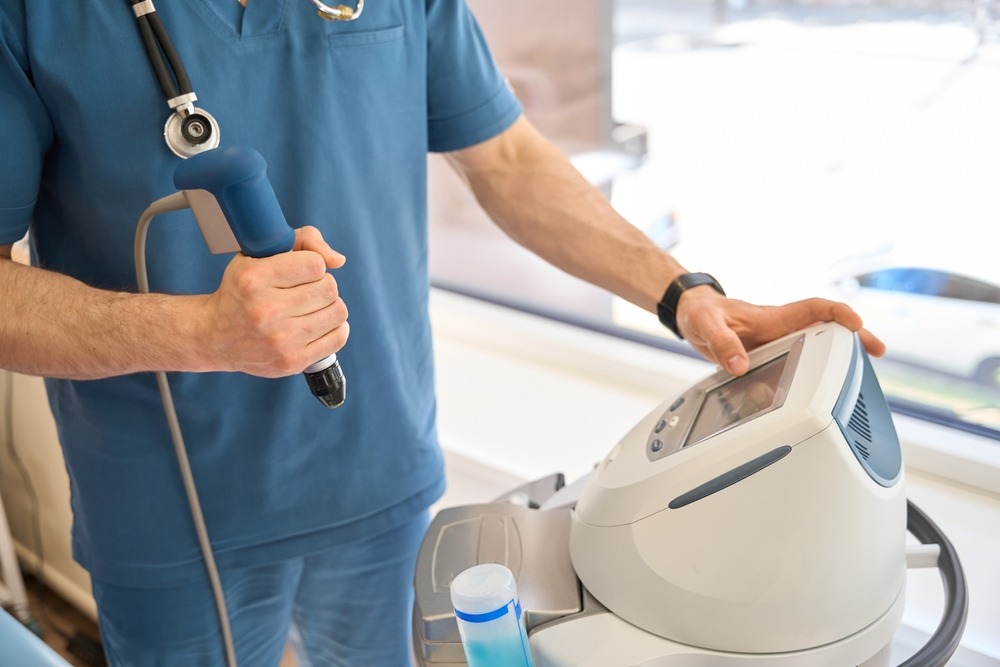
Extracorporeal Shockwave Therapy (ESWT) uses controlled acoustic waves that are delivered through the skin to the affected area without incisions or needles. Developed in the 1980s for kidney stone fragmentation, orthopaedic applications capitalised on shockwaves’ ability to stimulate bone and soft tissue regeneration.
Two delivery methods exist:
- – Focused ESWT: Precise deep penetration (4-12cm) for joints/tendons
- – Radial ESWT: Surface-level treatment for shallower conditions
Most treatment plans involve 3-6 sessions lasting approximately 10-20 minutes each, spaced 1-2 weeks apart.
How Shockwave Triggers Healing
One of the most common questions patients ask is how a series of sound waves can reduce pain and promote healing.
While the exact biological mechanisms are complex, the overall concept is relatively straightforward. High-pressure waves create controlled microtrauma that fragments calcifications and breaks down scar tissue while stimulating biological repair cascades. The negative pressure phase generates cavitation bubbles that implode, increasing cell membrane permeability and growth factor release.
Key mechanisms include:
- – Neovascularization via VEGF upregulation (20-50% increase)
- – Tenocyte proliferation and Type I collagen remodeling
- – Anti-inflammatory cytokine shift reducing pain mediators
- – Enhanced nutrient delivery to poorly vascularised tendons
In simple terms, shockwave therapy creates controlled stimulation within injured tissue, encouraging the body to increase blood supply, trigger repair pathways, and break down unhealthy tissue changes that may have accumulated over time.
Proven Applications by Condition
| Condition | Success Rate | Sessions | Best Candidates |
| Plantar Fasciitis | 68-80% | 3-5 | >6 months duration |
| Achilles Tendinopathy | 60-75% | 4-6 | Insertional/mid-portion |
| Tennis Elbow | 65-78% | 3-5 | Chronic epicondylitis |
| Calcific Tendinitis | 75-85% | 3-4 | Shoulder/hip deposits |
| Patellar Tendinopathy | 60-70% | 4-6 | Jumpers knee |
What Treatment Feels Like
Shockwave therapy is not usually described as painful. A handheld applicator is placed against the skin with ultrasound gel, and a series of 2000-4000 pulses are delivered to the affected tissue.
Patients rate discomfort level of 4-6/10 – no anaesthesia needed. Most tolerate well, and treatment intensity can be adjusted as needed.
Post-treatment timeline:
- – Days 1-3: Mild soreness/bruising
- – Week 1: Noticeable mobility improvement
- – Weeks 3-6: Peak biological response
- – Weeks 8-12: Maximal tissue remodeling
Many people expect immediate results, but shockwave therapy works by stimulating biological healing processes, which take time. Patience is important, as the benefits often continue to develop long after the treatment session itself.
Who Is Most Likely To Benefit?
Outcomes improve dramatically with proper patient selection:
High success (>70%):
- – Symptoms <12 months duration
- – Clear ultrasound/MRI pathology
- – Post-treatment loading compliance
Moderate success (50-60%):
- – Chronic tendinopathy >2 years
- – Partial tears/degenerative changes
Lower success (<40%):
- – Complete ruptures
- – Advanced joint destruction
Protocol Enhancement Factors
Shockwave therapy works best when integrated into a broader treatment plan rather than used as a standalone solution.
Factor | Outcome Boost | Implementation |
Ultrasound Guidance | +25% | Precise targeting |
Eccentric Loading | +30% function | Post-treatment exercise |
Full Course Compliance | +40% resolution | Complete 6 sessions |
Physio Combination | +20% durability | Concurrent rehab |
Experienced Operator | +15-20% | >100 cases/year |
Specialist Integration
Shockwave creates a “therapeutic window” where reduced pain enables strengthening and injections work better on revascularised tissue. Shockwave therapy can help restart the healing process, creating an opportunity for rehabilitation and strengthening to be more effective.
Before starting treatment, a specialist assessment helps confirm whether shockwave therapy is appropriate and safe, while identifying any conditions that may affect suitability, including pregnancy, blood-thinning medications, or local infection.
Consider specialist assessment if:
- – Pain persists despite physiotherapy and activity modification
- – Symptoms have lasted several months
- – Pain is affecting work, exercise, or sleep
- – Previous treatments have failed to provide lasting improvement
At Specialist Pain International Clinic (SPI) in Singapore, Dr Nicholas Chua incorporates shockwave therapy as part of a comprehensive pain management strategy.
Rather than treating pain in isolation, assessment focuses on identifying the underlying source of symptoms and determining whether shockwave therapy is likely to be beneficial. Where appropriate, treatment may be combined with rehabilitation, diagnostic imaging, targeted interventions, and lifestyle modifications to improve long-term outcomes.
For many patients with chronic tendon and soft tissue conditions, shockwave therapy provides a valuable non-invasive option that helps bridge the gap between conservative care and surgery.
- https://www.physio-pedia.com/Extracorporeal_Shockwave_Therapy
- https://theforburyclinic.co.uk/blog/what-is-shockwave-therapy-and-how-does-it-work/
- https://pmc.ncbi.nlm.nih.gov/articles/PMC7275282/
- https://shockwavemedical.com/ivl-overview/
- https://www.webmd.com/pain-management/what-is-shockwave-therapy
- https://www.storzmedical.com/us/physics-and-technology/
- https://ptsmc.com/soft-tissue-pain-management-the-advantages-of-shockwave-therapy/
- https://my.clevelandclinic.org/canada/services/shockwave-therapy
- https://www.frontiersin.org/journals/endocrinology/articles/10.3389/fendo.2023.1188297/full
- https://www.mayoclinic.org/medical-professionals/physical-medicine-rehabilitation/news/the-evolving-use-of-extracorporeal-shock-wave-therapy-in-managing-musculoskeletal-and-neurological-diagnoses/mac-20527246