Mt. Elizabeth Novena Medical Centre 38 Irrawaddy Road, #09-43 Singapore 329563
Mt. Elizabeth Novena Medical Centre 38 Irrawaddy Road, #09-43 Singapore 329563

Mt. Elizabeth Novena Medical Centre 38 Irrawaddy Road, #09-43 Singapore 329563
Mt. Elizabeth Novena Medical Centre 38 Irrawaddy Road, #09-43 Singapore 329563

Medically reviewed by Dr Nicholas Chua
Medical Director and Consultant in Pain Medicine and Anaesthesiology,
Specialist Pain International.
About Dr Chua · Research & Professional Contributions
Nucleoplasty: Removes or ablates a small amount of tissue from the disc’s centre to reduce pressure.
Annuloplasty: Uses controlled energy to treat part of the disc’s outer ring, with the aim of reducing disc-related pain.
Suitability: Depends on your symptoms, examination, scan findings and previous treatment.
Goals: Meaningful improvement in pain and daily function, alongside rehabilitation and follow-up care.
Nucleoplasty and annuloplasty are minimally invasive procedures that may be considered for selected people with persistent disc-related pain. They target different parts of a spinal disc and are used for different reasons.
Nucleoplasty aims to reduce pressure within a suitable disc. Annuloplasty targets the disc’s outer ring to help reduce pain arising from that area. Neither procedure is suitable for every slipped disc or type of back pain.
If pain continues despite medication, physiotherapy or other treatment, Dr Nicholas Chua at Specialist Pain International can assess your symptoms and discuss whether a disc procedure or another approach may be appropriate.
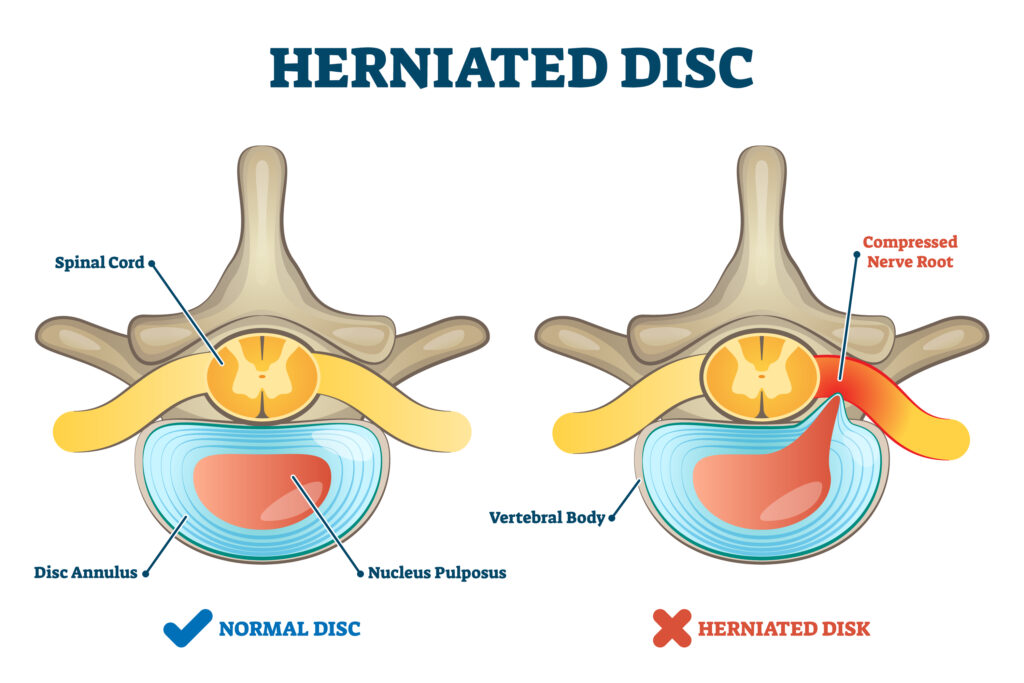
A normal disc vs a herniated (“slipped”) disc, showing how the soft centre can push through the outer ring and press on a nearby nerve. Not all disc-related pain involves nerve compression.
Spinal discs sit between the bones of your spine. Each disc has a softer centre, called the nucleus, surrounded by a tougher outer ring, called the annulus. Pain can arise from changes within the disc itself or from irritation of a nearby nerve. These situations can overlap, but they may require different treatment.
Discogenic back pain means pain thought to come from the disc itself. A herniated or “slipped” disc describes a structural change that may or may not cause symptoms. Sciatica describes pain travelling down the leg, commonly associated with irritation of a nerve in the lower back.
Read more about disc-related lower back pain and sciatica.
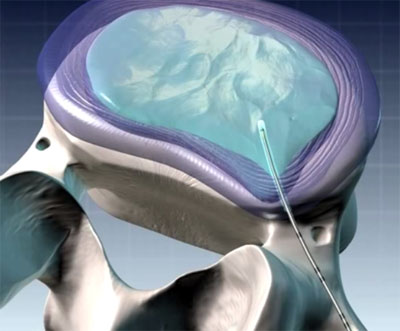
Nucleoplasty uses a small probe to remove a little tissue from the disc’s centre,
aiming to reduce pressure within the disc.
Nucleoplasty is a needle-based form of disc decompression. Your pain specialist places a small instrument into the disc using imaging guidance, then treats a small amount of tissue in its centre.
A commonly used technique involves coblation, which uses radiofrequency energy to create a plasma field that breaks down a small volume of disc tissue. The aim is to lower pressure within the disc and potentially reduce irritation affecting a nearby nerve.
You may hear it called plasma disc decompression, coblation nucleoplasty or percutaneous disc decompression. Different decompression techniques are not interchangeable, so your doctor should explain exactly which procedure is being considered.
Annuloplasty targets the annulus – the outer ring of the disc – rather than primarily removing tissue from its centre.
Disc changes and small fissures in this outer ring may contribute to pain in some patients. Thermal annuloplasty uses controlled energy to treat tissue and pain-sensitive nerve endings in the targeted area.
Several techniques exist, including intradiscal electrothermal treatment and radiofrequency approaches. Biacuplasty is one approach that uses cooled radiofrequency probes. These methods differ in how energy is delivered and in the evidence supporting their use.
Annuloplasty should not be understood as stitching a torn disc together, regrowing the disc or reliably reversing degeneration.
Nucleoplasty mainly aims to reduce pressure within a suitable disc. Annuloplasty aims to reduce pain associated with its outer ring. Both procedures are minimally invasive treatments for disc-related pain, but they target different parts of the disc and address symptoms through different mechanisms.
The distinction matters because pain travelling down the leg, particularly with numbness or weakness, may indicate nerve-root irritation or compression. That pattern is not necessarily treated by the same approach as predominantly discogenic low-back pain, which is pain thought to arise mainly from the disc itself.
Your doctor will assess your symptoms, medical history, physical examination findings and MRI results together to determine whether the imaging findings explain your symptoms. They may also recommend additional scans or diagnostic tests, when appropriate, to clarify the source of your pain and evaluate the relevant nerves, discs and surrounding structures. Based on this assessment, your doctor can recommend the treatment option most appropriate for your condition.
A pain specialist can assess persistent back or nerve-related pain and discuss medication, rehabilitation and appropriate procedures.
At Specialist Pain International, Mount Elizabeth Novena Medical Centre, Dr Nicholas Chua is the Medical Director and Consultant in Pain Medicine and Anaesthesiology.
A consultation with Dr Chua focuses on understanding your symptoms, reviewing previous care and discussing suitable next steps. Seeking an assessment does not commit you to having a procedure.
Your doctor will ask about:
The assessment may include checks of movement, strength, sensation and reflexes, together with a review of previous scans.
Further tests are considered only where they may help guide care. No single symptom or routine test reliably establishes that a disc is the source of pain.
The procedure is performed in a clinical setting using sterile precautions and imaging guidance.
After anaesthesia and any sedation have been arranged, a needle is guided into the selected disc. A small probe is passed through it to treat tissue in the disc’s centre. The equipment is then removed, and the entry site is covered.
Your team will explain the planned technique, monitoring and discharge arrangements. Some patients can return home the same day, depending on the procedure and their recovery.
A needle or catheter is positioned in the selected disc under imaging guidance. Depending on the method, one or more treatment probes deliver controlled energy to the targeted region.
Your doctor should explain whether the proposed procedure is electrothermal annuloplasty, biacuplasty or another technique. The equipment, treatment pattern and evidence differ.
The instruments are removed afterwards; these procedures do not normally leave a permanent stimulator or battery inside the body.
The aim is to make pain more manageable and support activities that matter to you. Improvement may be gradual, and rehabilitation remains important.
Many people experience worthwhile relief and improved function, although the amount of benefit varies. Some people may need further treatment, and no procedure can guarantee that surgery will be avoided or that symptoms will not return.
Your doctor should explain the evidence relevant to the exact procedure being proposed and help you understand what improvement may be realistic for you.
Possible complications include infection, bleeding, a temporary pain flare, injury to nearby structures and inadequate pain relief. Disc infection and nerve injury can be serious.
Further procedures or surgery may still be needed. Your individual risks depend on your health, the disc being treated and the technique used.
NICE’s guidance on electrothermal annulus treatment specifically emphasises discussing uncertain benefit, alternatives and the possibility of worsening pain after treatment.
Your care team will give you specific instructions about caring for the wound, taking medication, driving, returning to work, lifting and exercising.
Recovery times vary. Your doctor will advise when to resume each activity based on your procedure, symptoms and progress. Increase activity gradually and stop if it causes significant pain or other concerning symptoms.
Attend your follow-up appointments so your doctor can check your wound, pain, movement and recovery, and adjust your rehabilitation plan if needed.
Contact your care team promptly if you develop a fever, worsening pain, redness, swelling, discharge or opening of the wound, new weakness, or any other symptoms that concern you after treatment.
Depending on the assessment, options may include exercise-based rehabilitation, medication review, psychological support for persistent pain, selected nerve-targeted injections or surgical assessment.
Many people with a slipped disc improve without a disc procedure. When there is significant nerve compression or another structural problem requiring surgery, nucleoplasty or annuloplasty may not be an appropriate substitute.
Explore pain treatment options at Specialist Pain International.
Dr Nicholas Chua co-authored several papers on disc procedures such as The long-term efficacy and safety of percutaneous cervical nucleoplasty in patients with a contained herniated disk and Percutaneous Disc Decompression for Lumbar Radicular Pain: A Review Article, published in Pain Practice. It examined several approaches, including nucleoplasty, and discussed the evidence supporting their use.
Read more about Dr Chua’s research and professional contributions.
If persistent disc-related back or nerve pain is affecting your daily life, arrange a consultation with Dr Nicholas Chua at Specialist Pain International.
The consultation will focus on understanding your symptoms, reviewing previous treatment and discussing whether nucleoplasty, annuloplasty or another approach may be suitable.
If persistent back, leg or nerve pain is affecting your daily life, arrange a consultation with Dr Nicholas Chua at Specialist Pain International.
The consultation will focus on understanding your symptoms, reviewing previous treatment and discussing whether spinal cord stimulation or another approach may be suitable.
The consultation will focus on understanding your symptoms, reviewing previous treatment and discussing options to help you manage the pain.
Still unsure if you should see a pain specialist for your pain? We address some common questions about resolving pain and what we do below. Click the various questions to find out more!
Many slipped discs improve with appropriate non-operative care. A needle-based procedure may be considered for selected patients, while others may need surgical assessment. Treatment depends on the symptoms and findings. NHS information on slipped discs.
No. Nucleoplasty primarily treats tissue in the disc’s centre to reduce pressure. Annuloplasty targets its outer ring. They have different purposes and are not automatically performed together.
No. Facet radiofrequency treatment targets nerves supplying small joints at the back of the spine. Annuloplasty targets tissue within a disc. The appropriate target depends on the assessment.
These procedures do not usually involve leaving a permanent implant. They differ from spinal cord stimulation, which uses implanted leads and a generator.
Costs depend on the complexity of the procedure, number of discs treated, equipment, facility and follow-up arrangements. Contact our clinic Specialist Pain International for more information regarding your unique circumstances.
Seek emergency assessment for new difficulty passing urine, loss of bladder or bowel control, numbness around the genitals or anus, or rapidly worsening leg weakness associated with disc pain.

Specialist Pain International treats acute, chronic, and cancer pain with expert diagnosis, therapies, and patient-first care for faster recovery.
Explore
Address
Mt. Elizabeth Novena Medical Centre 38 Irrawaddy Road, #09-43 Singapore 329563
Operating Hours
Contact
WhatsApp us