

Key Summary:
Gentle stretching can ease lower back tightness and improve flexibility for many people, but studies show that stretching alone often gives only partial relief, especially when pain comes from discs, joints, or nerves rather than just muscle tension. The most effective programmes combine 4–5 key stretches with strengthening, posture changes, and, when necessary, specialist treatments like targeted injections and rehabilitation at centres such as Specialist Pain International Clinic in Singapore with Dr Nicholas Chua.
A tight, aching lower back is one of the most common reasons people start stretching—often after long hours sitting, standing, or lifting. Many feel temporary relief, only for the pain to return the next day or after a week of good intentions. This guide outlines five essential stretches that can genuinely help, and explains clearly why stretching alone often fails when deeper structures like discs, joints, or nerves are involved.
Understanding Lower Back Pain: Muscle vs Structure
Not all lower back pain is the same. Some episodes come mainly from tight or overworked muscles, while others arise from irritated joints, discs, or nerve compression. Stretches target soft tissues and can reduce muscle guarding, but they cannot:
- – Reverse significant disc bulges.
- – Realign arthritic facet joints.
- – Decompress nerves in a narrowed spinal canal.
This is why many people experience only short‑term relief from stretching, particularly if they have long‑standing pain or symptoms into the legs.
5 Essential Stretches for Lower Back Relief
Important: Perform these gently, within a comfortable range. Stop and seek medical advice if you experience sharp pain, increasing leg symptoms, or significant weakness.
1. Knees‑to‑Chest Stretch (Single or Double)
Purpose: Gently opens the lower spine and stretches muscles at the back.
How to do it:
- – Lie on your back with knees bent, feet on the floor.
- – Bring one knee towards your chest, holding with both hands for 15–20 seconds, then switch.
- – If comfortable, you can try bringing both knees to your chest together.
Helps with: General muscle tightness and mild disc‑related stiffness, particularly after prolonged sitting.
2. Child’s Pose (Modified for Back Pain)
Purpose: Lengthens the lower back and hips in a supported way.
How to do it:
- – Kneel on a mat, sit back towards your heels, and gently reach your arms forwards on the floor.
- – If this is too strong, widen your knees slightly or place a cushion between your thighs and calves.
- – Hold for 20–30 seconds, breathing steadily.
Helps with: Global back tightness and stress‑related tension, especially at the end of the day.
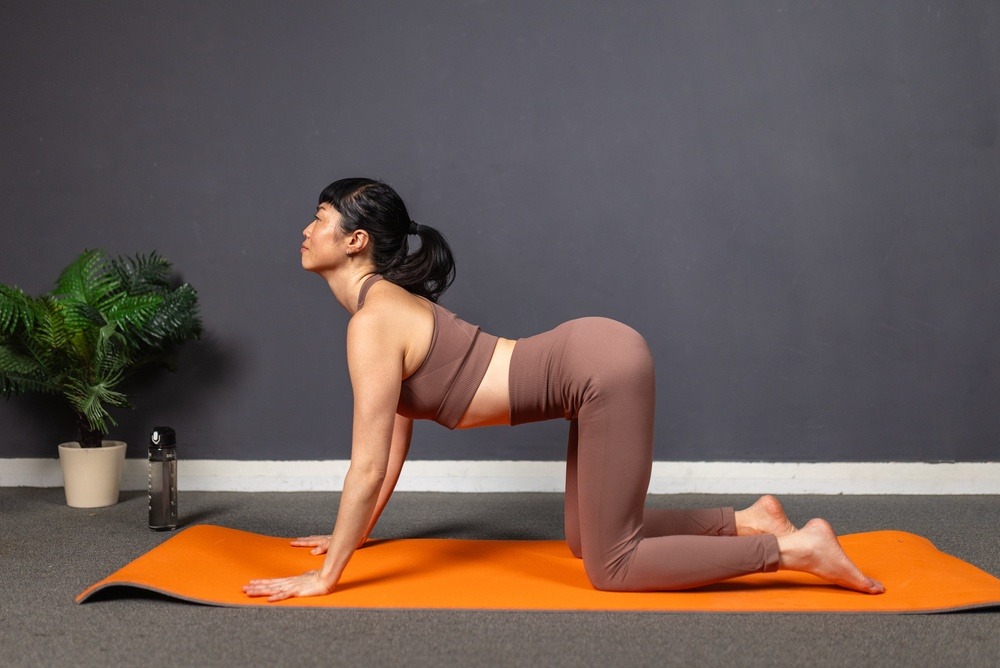
3. Cat–Cow Mobilisation
Purpose: Improves mobility through the spine in a controlled, pain‑free range.
How to do it:
- – Start on hands and knees with hands under shoulders and knees under hips.
- – Slowly arch your back upwards (cat), then gently drop it down while lifting your chest (cow).
- – Move smoothly between positions 8–10 times.
Helps with: Morning stiffness and “rusty” feeling across the lower and mid‑back.
4. Hip Flexor Stretch (Half‑Kneeling)
Purpose: Reduces front‑of‑hip tightness that pulls the pelvis and stresses the lower back.
How to do it:
- – Kneel on one knee with the other foot in front, forming a 90‑degree angle at both knees.
- – Keeping your trunk upright, gently shift your weight forward until you feel a stretch at the front of the hip on the kneeling side.
- – Hold 20–30 seconds, then switch legs.
Helps with: Back pain linked to prolonged sitting, where tight hip flexors tilt the pelvis forward.
5. Hamstring Stretch (Supported)
Purpose: Loosens the back of the thighs, which can reduce pulling on the pelvis.
How to do it:
- – Lie on your back near a doorway.
- – Place one leg up against the wall or doorframe, keeping it comfortably straight, while the other leg rests on the floor through the doorway.
- – Hold 20–30 seconds, then change sides.
Helps with: Lower back discomfort associated with tight hamstrings, particularly in people who sit a lot or are less active.
Summary Table: Stretches and Their Main Roles
Stretch | Main Target Area | Typical Benefit | Best For |
Knees‑to‑Chest | Lower back muscles, discs | Reduces general tightness, eases stiffness | After sitting, mild disc‑related aches |
Child’s Pose | Whole back, hips | Relaxes spine, calms tension | End‑of‑day soreness, stress‑linked pain |
Cat–Cow | Spinal joints, muscles | Improves flexibility, warms up the spine | Morning stiffness, pre‑exercise mobilisation |
Hip Flexor Stretch | Front of hip, pelvis | Reduces pulling on lower back | Desk workers, prolonged sitting |
Hamstring Stretch (Supported) | Back of thigh, pelvis | Lessens downward pull on pelvis and spine | Tight legs, sedentary or post‑sport stiffness |
Why Stretching Alone Often Fails
Short‑Term Muscle Relief vs Long‑Term Causes
Stretches mainly target muscles and short‑term stiffness. Many people feel better immediately after stretching because muscle tension decreases and blood flow improves. However, if the main problem is a worn facet joint, irritated disc, or spinal stenosis, stretching alone does not correct the underlying issue. Pain then returns, sometimes within hours.
Missing Strength and Stability
A common reason stretching fails is that it is not paired with strengthening. The lower back and core need adequate support from surrounding muscles. Without strength, the spine remains vulnerable to load, and muscles keep tightening up as a protective response.
Ignoring Work and Lifestyle Factors
Even the best stretching routine cannot undo:
- – A poorly set‑up desk,
- – Long periods of sitting or standing without breaks, or
- – Repeated heavy lifting with poor technique.
If these drivers are not addressed, the same strains will repeatedly overload the back.
When Stretching May Be Unhelpful or Risky
Certain patterns suggest that stretching without guidance may be inappropriate or even aggravating:
- – Sharp, shooting pain down the leg during or after stretches.
- – Increasing numbness, tingling, or weakness.
- – Severe pain that worsens with particular positions and does not ease quickly.
In such cases, continuing to stretch “through the pain” can irritate nerves or inflamed structures further.
Where Stretching Fits in a Complete Plan
A more effective approach is to see stretching as one part of a broader strategy:
Component | Role in Back Care |
Stretching | Reduces short‑term muscle tightness |
Strengthening (core, hips) | Provides support, reduces recurrent strain |
Ergonomics & posture | Lowers daily load on the spine |
Activity pacing & breaks | Prevents overload from long sitting or standing |
Targeted medical treatments | Address structural pain sources when necessary |
When to Consider a Clinical Assessment
You should consider seeing a pain specialist or spine‑aware clinician if:
- – Pain has lasted more than a few weeks despite regular, sensible stretching.
- – You have difficulty walking far, standing, or sitting without significant pain.
- – Symptoms radiate into the legs, or you notice numbness, tingling, or weakness.
- – Back pain wakes you at night or is associated with weight loss, fever, or other concerning signs
Role of Specialist Pain International Clinic in Singapore
Specialist Pain International Clinic (SPI) in Singapore, led by Dr Nicholas Chua at Mount Elizabeth Novena, evaluates lower back pain ranging from muscle‑dominant “office back” to disc, joint, and nerve‑related conditions. After a detailed assessment, management may include:
- – Clarifying whether your pain is mainly muscular, joint, disc, or nerve‑driven.
- – Recommending an appropriate combination of stretching, strengthening, posture changes, and activity modification.
- – Offering targeted, image‑guided treatments—such as facet joint injections, epidural injections, or other minimally invasive procedures—when structural issues are present.
- – Coordinating rehabilitation so that any pain relief you gain from procedures is reinforced by exercise and ergonomic changes, not just stretching.
If you feel you are “stretching every day” but your lower back still controls your routine, a structured clinical review can help identify what is missing from your plan—and which steps are most likely to give you more reliable, longer‑term relief
Links:
- https://journals.sagepub.com/doi/10.1177/20503121241252251
- https://www.scirp.org/journal/paperinformation?paperid=74887 https://pubmed.ncbi.nlm.nih.gov/23266331/
- https://pmc.ncbi.nlm.nih.gov/articles/PMC12354564/ https://pmc.ncbi.nlm.nih.gov/articles/PMC12045001/
- https://pubmed.ncbi.nlm.nih.gov/36958977/ https://bjsm.bmj.com/content/54/21/1279
- https://www.health.harvard.edu/pain/stretching-and-strengthening-exercises-to-relieve-and-prevent-lower-back-pain
- https://jamanetwork.com/journals/jamainternalmedicine/fullarticle/1106098
- https://www.aafp.org/pubs/afp/issues/2022/1000/cochrane-low-back-pain.html