Mt. Elizabeth Novena Medical Centre 38 Irrawaddy Road, #09-43 Singapore 329563
Mt. Elizabeth Novena Medical Centre 38 Irrawaddy Road, #09-43 Singapore 329563

Mt. Elizabeth Novena Medical Centre 38 Irrawaddy Road, #09-43 Singapore 329563
Mt. Elizabeth Novena Medical Centre 38 Irrawaddy Road, #09-43 Singapore 329563
Medically reviewed by Dr Nicholas Chua
Medical Director and Consultant in Pain Medicine and Anaesthesiology,
Specialist Pain International.
About Dr Chua · Research & Professional Contributions
Treatment: An implanted system delivers small electrical pulses through thin medical wires called leads.
Suitability: Depends on your pain condition, previous treatment, health and assessment findings.
Trial: A temporary stimulation trial helps assess your response before deciding about a permanent implant.
Goals: Meaningful improvement in pain and daily function, with ongoing review and support
Spinal cord stimulation (SCS) is a treatment that may help selected people with persistent back, leg or nerve pain when other treatments have not provided enough relief. It uses a small implanted device to deliver electrical pulses near the spinal cord, changing how pain signals are processed.
If pain continues despite medication, physiotherapy, injections or previous back surgery, an assessment can help you understand your options. Dr Nicholas Chua at Specialist Pain International can review your symptoms and discuss whether SCS deserves further consideration.
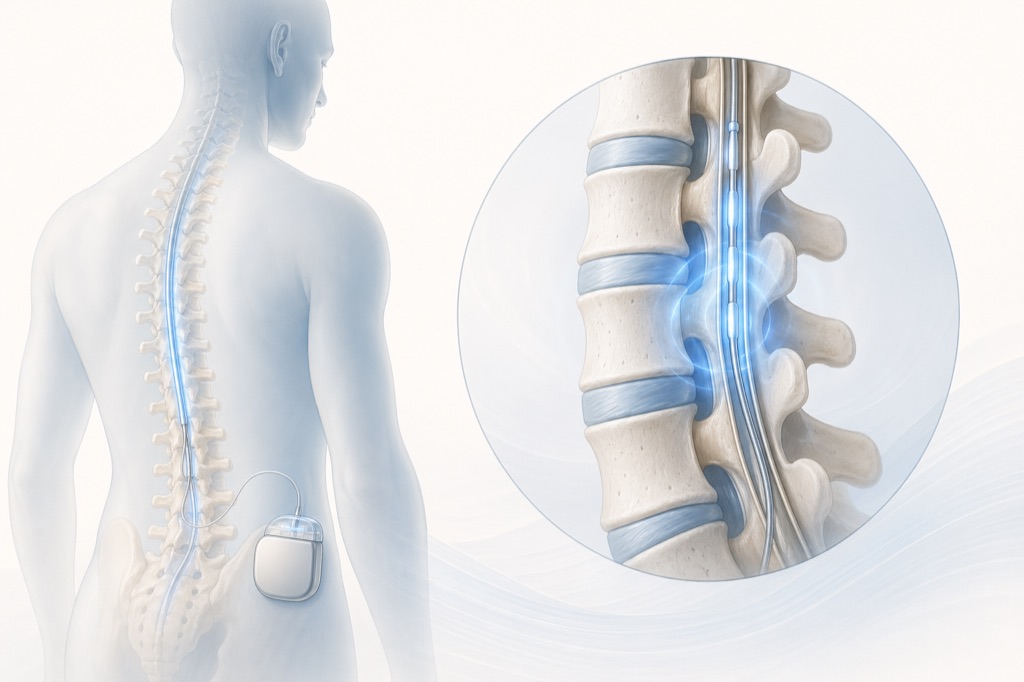
Spinal cord stimulation uses thin leads positioned in the epidural space, outside the spinal cord’s protective covering. These connect to a device called a pulse generator. With a permanent implant, the generator sits beneath the skin. A controller allows you to make adjustments within the settings provided by your healthcare team.
You may hear this treatment described as a spinal cord stimulator implant, SCS implant, spinal stimulator or implanted pain stimulator. It is one type of neuromodulation, a term for treatments that change nerve signalling.
Pain messages travel through the nervous system to the brain. SCS delivers electrical stimulation intended to change how some of these messages are processed.
Depending on the system and programme, you may feel tingling or may not even feel the stimulation at all.
The aim is to reduce the impact of pain, as the implant does not repair a slipped disc, remove pressure on a nerve or change the structure that is causing the pain. There is no guarantee for complete relief, and individual responses vary. Nevertheless, more than half of patients experience significant pain relief during the trial period, with more than two-thirds of patients opting for permanent SCS implantation.
Not everyone is suitable for SCS – your doctor needs to establish whether your pain pattern and medical circumstances are suitable for the treatment. SCS is generally considered after appropriate treatments have not provided sufficient relief. It may be helpful to selected patients with persistent nerve-related pain, including some people with pain after spinal surgery or complex regional pain syndrome.
That said, having chronic back pain, sciatica or an abnormal MRI does not mean that an implant is immediately suitable. Therefore, patient selection and assessment are important to ensure that the treatment is appropriate for your condition and circumstances.
You can also explore back pain assessment and treatment at Specialist Pain International.
A trial lets you experience spinal cord stimulation before deciding whether to have a permanent system implanted. The main purpose is to see whether stimulation provides enough relief, improved function or better quality of life to make permanent implantation worthwhile.
Temporary leads are placed near the spinal cord and connected to a generator worn outside the body. The leads are usually left in place for about 3–7 days depending on the discussion with your doctor. During this time, your care team explains how to use the external generator, protect the trial equipment and record changes in pain, sleep, movement and daily activities.
The trial is not looking for complete elimination of pain. Instead, meaningful change means a noticeable improvement that makes a real difference in your daily life. Your team will consider whether your pain has decreased, whether you can do activities more comfortably, whether the stimulation is tolerable, and whether the benefits are consistent enough for you to want a permanent SCS implant. You may be asked to keep a pain and activity diary and discuss your experience at the follow-up visit.
After the trial, your care team removes the temporary leads and reviews the results with you. If the response is insufficient or the equipment is difficult to manage, permanent implantation may not be recommended.
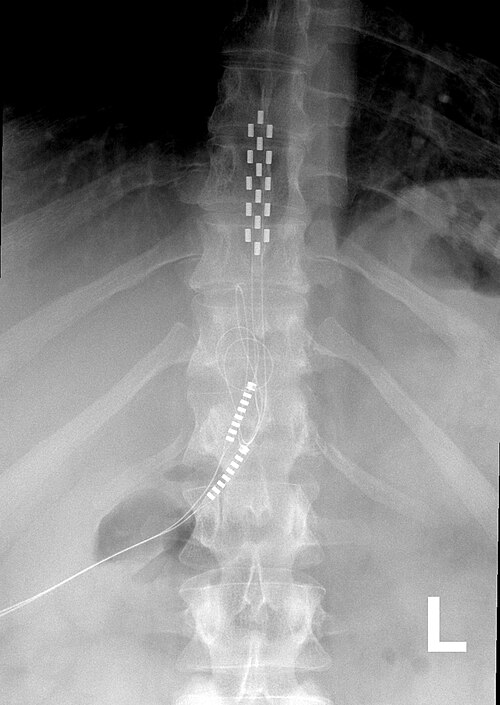
If implantation is recommended and you decide to proceed, the treating team will explain the planned procedure, anaesthesia and hospital arrangements.
The permanent system includes stimulation leads, which are placed in the target area, and a small generator, or battery, which is implanted beneath the skin. The leads are connected to the generator, which delivers carefully adjusted electrical stimulation. Depending on the system used, the generator may be placed in the chest, abdomen or another suitable location.
After the procedure, the device will be checked and programmed to provide the intended treatment. Programming is often adjusted over several appointments as your treating team assesses your symptoms, response and any side effects. It may take time to find the settings that work best for you, and you may need to keep a record of changes in your symptoms or daily activities.
Follow-up appointments are an important part of treatment. They allow the team to check the surgical sites, review your progress, adjust the stimulation settings and discuss any practical issues, such as charging the device or managing the generator.
Treatment goals should reflect what matters to you: walking more comfortably, sleeping with fewer interruptions or participating more fully in rehabilitation.
That said, results can vary. Some people experience worthwhile improvement; others have limited relief or find that benefit changes over time. This is why patient selection is crucial and permanent implantation is only done after a successful trial and shared decision making between doctor and patient.
SCS is usually part of broader pain management rather than a replacement for all other care. Do not reduce or stop prescribed medication without discussing it with your doctor.
While SCS implantation is generally safe under a skilled specialist, possible complications include infection, bleeding, pain around the implant, lead movement, device problems and inadequate relief. Serious complications, including nerve injury, may potentially occur.
Some problems require another procedure to reposition, replace or remove equipment. Before your procedure, your doctor should explain your individual risks , solutions, and alternatives.
You will receive instructions about wound care, movement, driving, work and exercise. Follow-up includes reviewing healing and adjusting the programme.
Some devices require charging. MRI eligibility depends on the exact system and scanning conditions, so tell healthcare professionals about your implant before investigations or procedures.
Seek prompt advice for fever, wound concerns or new neurological symptoms after treatment. Follow the specific instructions provided by your team.
Depending on the cause of pain, options may include medication review, rehabilitation, psychological support, targeted procedures or surgical assessment.
The most appropriate next step is not always another procedure. Your doctor should explain why SCS is being considered and how it compares with the alternatives in your circumstances.
Explore pain treatment options at Specialist Pain International.
Dr Nicholas Chua co-authored Pulsed Radiofrequency Treatment for Trigeminal Neuralgia, published in Anesthesiology and Pain Medicine. The study investigated pulsed radiofrequency treatment targeting the trigeminal ganglion, a collection of nerve cells involved in facial sensation.
Read more about Dr Chua’s research and professional contributions.
Bring previous MRI or CT reports, surgery summaries, a medication list and details of treatments you have tried.
A short pain diary can help. Record where the pain occurs, what makes it worse, what helps and which activities you are struggling with.
Tell Dr Chua what you hope treatment will change. These goals help guide the discussion about whether further SCS assessment is appropriate.
If persistent back, leg or nerve pain is affecting your daily life, arrange a consultation with Dr Nicholas Chua at Specialist Pain International.
The consultation will focus on understanding your symptoms, reviewing previous treatment and discussing whether spinal cord stimulation or another approach may be suitable.
The consultation will focus on understanding your symptoms, reviewing previous treatment and discussing options to help you manage the pain.
Still unsure if you should see a pain specialist for your pain? We address some common questions about resolving pain and what we do below. Click the various questions to find out more!
No. TENS, or transcutaneous electrical nerve stimulation, delivers mild electrical stimulation through adhesive pads placed on the skin. It is typically used for temporary or at-home pain relief and does not require a surgical procedure or implanted device.
Spinal cord stimulation, or SCS, uses thin leads placed near the spinal cord or targeted nerves to deliver electrical impulses that can help interrupt or change pain signals before they reach the brain.
Because SCS delivers stimulation closer to the nerves involved in pain, it can provide more targeted and consistent relief for some people with chronic pain. SCS may also be more convenient for long-term use because it does not require repeatedly applying skin pads or carrying an external device. However, SCS is an implanted treatment that requires a medical procedure and is not automatically better for everyone. TENS is noninvasive, easy to try, and may be appropriate for temporary or milder pain.
Not necessarily. Previous surgery is only one consideration. Suitability depends on the diagnosis, prior treatment and the specific device’s indications.
No. It is a treatment intended to help manage pain. Ongoing rehabilitation, medication or other support may still be needed.
No. The trial helps inform the decision as to whether you should proceed with permanent implantation. You and your treating team will review the response before discussing whether to proceed.
Contact your care team if the pain relief reduces. A review may involve programming adjustments, assessment of changes in your condition or investigation of the device.
Sometimes it may be considered among the options for persistent pain, but it does not replace surgery needed to address a problem such as significant nerve compression or spinal instability.
New difficulty passing urine, loss of bladder or bowel control, numbness around the genitals or anus, or rapidly worsening leg weakness requires urgent medical assessment. Do not wait for a routine SCS appointment.
Costs depend on the assessment, trial, implant, and hospital arrangements. Ongoing care would be needed for your implant including possible future battery replacement. Consult our clinic to understand more about the estimate cost and insurance coverage based on your policy and approval requirements

Specialist Pain International treats acute, chronic, and cancer pain with expert diagnosis, therapies, and patient-first care for faster recovery.
Explore
Address
Mt. Elizabeth Novena Medical Centre 38 Irrawaddy Road, #09-43 Singapore 329563
Operating Hours
Contact
WhatsApp us